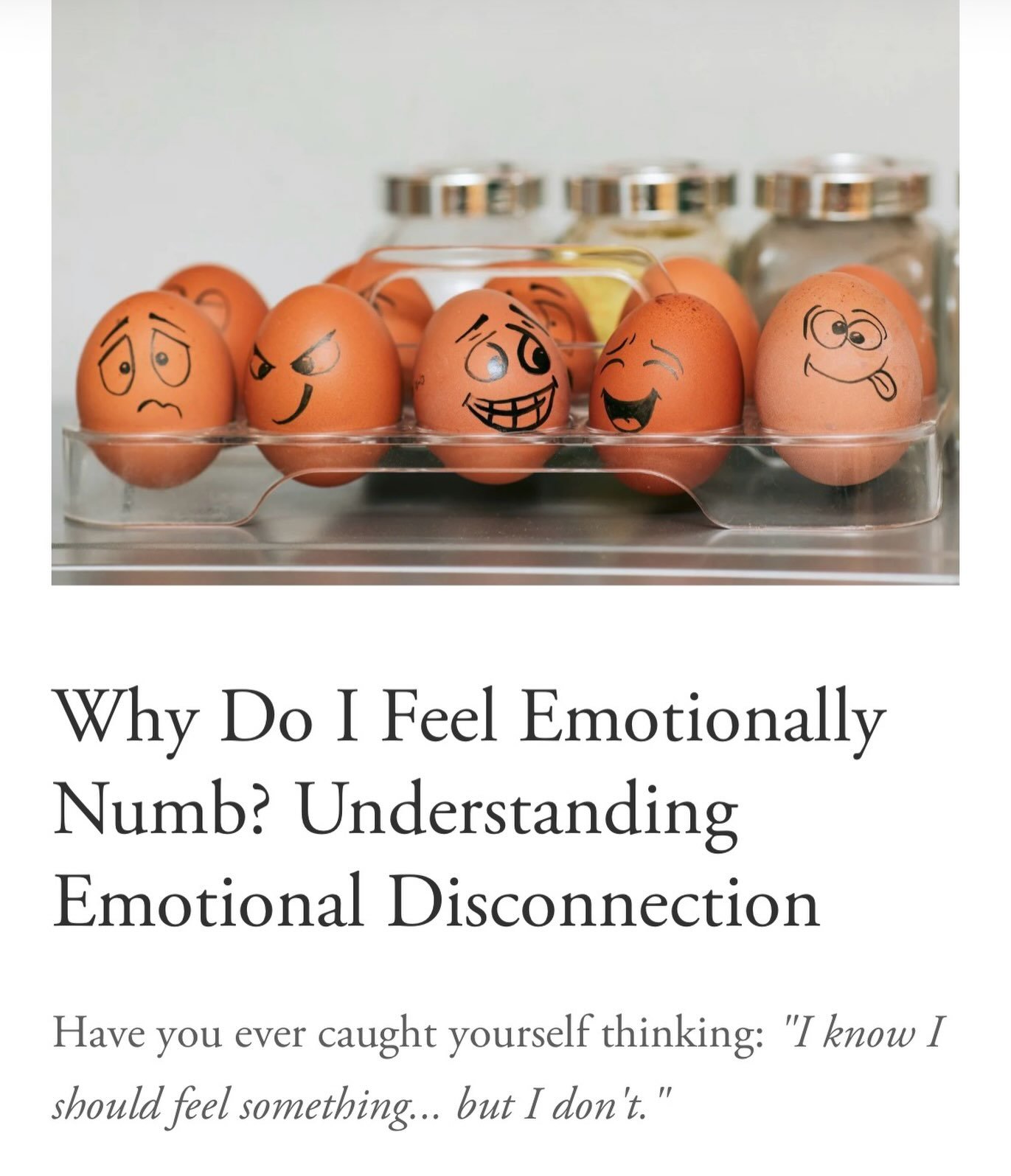
Why Do I Feel Emotionally Numb? Understanding Emotional Disconnection

Why Do I Feel Emotionally Numb? Understanding Emotional Disconnection

Have you ever caught yourself thinking: "I know I should feel something... but I don't."

Maybe you don't cry anymore, even when something painful happens. Maybe you feel disconnected from the people you love, struggle to feel excitement, or move through life on autopilot.

Many people worry that emotional numbness means something is wrong with them.

In reality, emotional numbness is often a sign that your nervous system has been working very hard to protect you.

What is emotional numbness?

Emotional numbness is the experience of feeling disconnected from your emotions. Instead of feeling joy, sadness, anger, or excitement, you might feel flat, empty, or as though you're simply going through the motions.

Some people describe it as:

  • Feeling like you're watching your life instead of living it.

  • Not caring about things you used to enjoy.

  • Feeling disconnected from your partner, friends, or family.

  • Struggling to cry or express emotions.

  • Feeling "fine" even though you know you're overwhelmed.

Numbness isn't the absence of emotion. It's often a protective response.

Why does emotional numbness happen?

Your nervous system is constantly trying to keep you safe.

When life becomes overwhelming, whether from chronic stress, burnout, trauma, grief, or ongoing emotional demands, it may decide that feeling everything is simply too much.

Rather than allowing intense emotions to flood your system, it turns the volume down.

Unfortunately, it can't selectively numb only the painful emotions.

When we lose access to sadness or fear, we often lose access to joy, excitement, and connection too.

Signs your nervous system may be overwhelmed

Emotional numbness often happens alongside other symptoms, including:

  • Constant exhaustion

  • Brain fog

  • Feeling detached from yourself

  • Difficulty making decisions

  • Loss of motivation

  • Irritability

  • Trouble feeling connected to others

  • Going through daily routines without feeling present

These experiences aren't signs of weakness. They're often signs that your nervous system has been carrying too much for too long.

You can't force yourself to feel

When people notice they're emotionally numb, they often try harder.

They tell themselves to be grateful.

To think positively.

To "snap out of it."

Unfortunately, our nervous systems don't respond well to pressure.

Healing usually begins by creating enough safety for emotions to return naturally, not by forcing them.

How therapy can help

Therapy isn't about making you feel everything all at once.

In fact, moving too quickly can sometimes feel overwhelming.

Instead, therapy helps you gradually reconnect with yourself in a way that feels manageable.

Depending on your needs, this might involve:

  • Learning how your nervous system responds to stress.

  • Understanding how past experiences may still be affecting you today.

  • Working with protective parts of yourself through Internal Family Systems (IFS).

  • Using EMDR to process experiences that your nervous system hasn't fully integrated.

  • Incorporating somatic techniques that help you reconnect with your body safely.

Healing isn't about becoming emotional overnight.

It's about expanding your capacity to experience life again.

Emotional numbness is not your personality

One of the biggest fears people have is that they've "lost themselves."

The truth is, the part of you that feels connected, playful, loving, and alive is often still there.

It's just been buried beneath layers of protection.

With time, safety, and support, many people find that those feelings slowly begin to return.

Therapy for emotional numbness in Calgary

If you're feeling emotionally disconnected, burnt out, or like you're simply surviving each day, you don't have to figure it out alone.

Therapy can help you understand why your nervous system has gone into protection mode and gently support you in reconnecting with yourself.

Whether your emotional numbness is related to trauma, chronic stress, anxiety, or burnout, healing is possible and it doesn't require forcing yourself to "just feel."

You deserve to experience life with more connection, presence, and ease.

Please feel free to contact me for a free 15 minute consultation to learn more.

The Mother Wound: Understanding the Invisible Impact of Your Relationship with Your Mother

The Mother Wound: Understanding the Invisible Impact of Your Relationship with Your Mother

When people hear the phrase mother wound, they often assume it means blaming their mom.

It doesn't.

The mother wound isn't about deciding whether your mother was "good" or "bad." It's about understanding how our earliest relationship can shape the way we see ourselves, connect with others, and move through the world.

Many people carry a mother wound without realizing it. They simply know that they struggle with self-worth, boundaries, people-pleasing, or feeling like they're never enough.

Understanding the mother wound isn't about assigning blame; it's about making sense of patterns that may no longer be serving you.

What is the mother wound?

The mother wound refers to the emotional pain that develops when our needs for safety, attunement, acceptance, or nurturing weren't consistently met by our primary caregiver.

This can happen for many reasons.

Perhaps your mother was emotionally unavailable because she was overwhelmed, depressed, struggling with her own trauma, or simply wasn't shown how to meet emotional needs herself.

Maybe she was highly critical, unpredictable, controlling, or expected you to take care of her emotions instead of the other way around.

Or perhaps she loved you deeply but wasn't able to offer the emotional connection you needed.

The impact isn't determined by intention.

It's determined by what your nervous system experienced.

Signs you may be carrying a mother wound

Everyone's experience is different, but common signs include:

  • Feeling like you have to earn love

  • Being overly responsible for other people's feelings

  • Difficulty asking for help

  • Feeling guilty when you set boundaries

  • Perfectionism and harsh self-criticism

  • Fear of disappointing others

  • Difficulty trusting your own needs

  • Feeling "too much" or "not enough."

  • Choosing relationships where you have to work hard for connection

These patterns often develop as creative ways to stay connected to the people we depended on.

The mother wound doesn't always come from obvious trauma

Many people minimize their experiences because they weren't physically abused or neglected.

They'll say things like:

"My mom did the best she could."

That may be true.

And...

You can hold compassion for your mother's story while also acknowledging the impact her limitations had on you.

Both things can exist at the same time.

Healing doesn't require deciding that your mother was a villain.

The collective mother wound

The mother wound is also bigger than individual families.

Many women have been raised in cultures that taught them to ignore their own needs, prioritize everyone else, suppress difficult emotions, and seek worth through caregiving or achievement.

These messages are often passed from one generation to the next.

Sometimes mothers unintentionally teach their children the same survival strategies they once needed:

  • Don't take up too much space

  • Be nice

  • Don't make people uncomfortable

  • Keep the peace

  • Work harder

  • Don't be emotional

  • Make sure everyone else is okay first

This is sometimes referred to as the collective mother wound, the ways that family patterns, cultural expectations, and intergenerational trauma shape how we relate to ourselves and one another.

Recognizing these patterns isn't about blaming previous generations.

It's about understanding the systems they were surviving within and deciding what you want to carry forward.

Healing the mother wound

Healing doesn't happen by pretending the wound never existed.

It happens by gradually giving yourself the experiences you may not have consistently received.

That might include:

Learning to notice your own needs

Many people with a mother wound become experts at noticing everyone else's emotions while losing touch with their own.

Healing often begins by asking yourself:

What do I need right now?

It may feel unfamiliar at first and that's okay.

Building self-compassion

If you've internalized a critical or demanding voice, learning to relate to yourself with kindness can feel surprisingly difficult.

Rather than trying to silence your inner critic, becoming curious about what it's protecting can create space for change.

Grieving what you didn't receive

One of the hardest parts of healing is allowing yourself to grieve.

Not necessarily the loss of your mother, but the loss of the relationship you needed and deserved.

Grief can coexist with love.

Creating healthier boundaries

If you learned that love meant self-sacrifice, boundaries may feel selfish or unsafe.

Over time, boundaries can become an act of self-respect rather than rejection.

Finding relationships that feel emotionally safe

Healing often happens in relationship.

Whether it's with trusted friends, a partner, or a therapist, experiencing consistent, attuned relationships can help your nervous system learn that connection doesn't have to be earned.

Therapy for healing the mother wound in Calgary

The mother wound isn't something you simply "get over."

It's something you gently begin to understand.

In therapy, we can explore how your early relationships continue to shape your nervous system, your relationships, and the way you relate to yourself today.

Using approaches such as Internal Family Systems (IFS), EMDR, somatic therapy, and other trauma-informed approaches, we can work with the protective patterns that once helped you survive while creating space for greater self-trust, self-compassion, and authentic connection.

Healing the mother wound isn't about becoming someone new.

It's about reconnecting with the parts of yourself that learned they had to shrink, strive, or stay silent in order to belong.

You deserve relationships, including the one you have with yourself, that are rooted in safety, acceptance, and care.

Why Am I So Hard on Myself? Understanding Your Inner Critic


Why Am I So Hard on Myself? Understanding Your Inner Critic

Have you ever noticed that you speak to yourself in a way you'd never speak to someone you love?

Maybe you constantly replay conversations, criticize every mistake, compare yourself to others, or feel like nothing you do is ever enough. Even when someone compliments you, a voice inside quickly dismisses it.

If this sounds familiar, you're not alone.

Many people come to therapy wondering why they're so hard on themselves. The answer often isn't that you're "too sensitive" or simply have low self-esteem. More often, that harsh inner voice developed for a reason.

What is the inner critic?

The inner critic is the part of you that judges, pressures, shames, or pushes you to do better.

It might sound like:

  • "You should have done better."

  • "You're lazy."

  • "You're too much."

  • "You're not good enough."

  • "If you make a mistake, people will reject you."

  • "You need to keep trying harder."

Although it feels cruel, the inner critic usually isn't trying to hurt you.

It's often trying to protect you.

Why do we develop an inner critic?

Our inner critic rarely appears out of nowhere. It often develops through our experiences.

You may have grown up in an environment where:

  • Love or approval felt conditional.

  • Mistakes were criticized or punished.

  • You were expected to be the responsible one.

  • Your emotions weren't welcomed.

  • You learned that being "good enough" kept you safe.

Over time, those external messages can become internal ones.

Your nervous system learns that staying vigilant, striving for perfection, or criticizing yourself first might prevent rejection, failure, or disappointment.

The inner critic becomes a survival strategy.

The problem with self-criticism

While your inner critic may have helped you survive difficult experiences, it often creates new struggles later in life.

Constant self-criticism can contribute to:

  • Anxiety

  • Depression

  • Burnout

  • Perfectionism

  • People-pleasing

  • Low self-worth

  • Difficulty relaxing

  • Feeling like you're never enough

Ironically, the more we criticize ourselves, the harder it often becomes to make meaningful changes.

Shame tends to shut us down, not motivate us.

You don't need to silence your inner critic

Many people think the goal is to get rid of their inner critic completely. In therapy, that's usually not the goal.

Instead, we become curious.

Rather than asking, "How do I make this part disappear?" we ask:

  • What is this part afraid would happen if it stopped criticizing me?

  • When did it first learn this job?

  • What is it trying to protect?

  • What does it need?

When we approach the inner critic with curiosity instead of fighting it, it often begins to soften on its own.

Working with the inner critic through Internal Family Systems (IFS)

Internal Family Systems (IFS) views the mind as made up of different "parts," each with its own role.

Your inner critic is often a protective part. It may believe that if it keeps pushing you, you'll avoid failure, rejection, or emotional pain.

Instead of seeing this part as the enemy, IFS helps us understand it.

As we build trust with protective parts, they often become less extreme. This creates space for more confidence, self-compassion, and flexibility.

You don't have to force positive affirmations or convince yourself to "just think differently."

Real change happens when the parts of you that learned to survive no longer have to work so hard.

Self-compassion isn't letting yourself off the hook

One of the biggest fears people have is that if they stop being hard on themselves, they'll become lazy or stop achieving.

In reality, research suggests the opposite.

People who practice self-compassion are often more resilient, more willing to learn from mistakes, and better able to recover after setbacks.

Being kind to yourself doesn't mean lowering your standards.

It means supporting yourself in the same way you'd support someone you care about.

Therapy for self-criticism in Calgary

If you're exhausted by constantly feeling like you're not enough, therapy can help you understand where that inner voice came from and develop a different relationship with it.

Using approaches such as Internal Family Systems (IFS), EMDR, somatic therapy, and trauma-informed therapy, we can gently explore the protective role your inner critic has been playing while helping you build greater self-compassion and emotional safety.

You don't have to keep fighting yourself.

You deserve to experience what it's feels like to have an inner voice that supports you instead of tears you down.

If you're looking for therapy for self-criticism, perfectionism, anxiety, or trauma in Calgary, I'd be honoured to support you.

IFS_Therapist Instagram Account

Hi everyone,

Welcome! My name is Diandra Lewis, registered psychologist in Mohkinstsis (Calgary, Alberta). Please feel free to visit and follow my instagram page to learn more about Internal Family Systems (IFS) therapy. If you live in Alberta or Nunavut please feel free to contact me for an appointment or free 15 minute phone consultation.

What would someone with self-worth do?

What would someone with self-worth do?

Many of us struggle with low self-esteem or maybe we have that nagging critical voice that follows us around saying we’re not good enough.  This can feel overwhelming, depressing, anxiety-provoking and many more difficult emotions. If this is a pattern that you recognize in yourself, what can you do?  One of the pieces to look at is self-worth.